March 12, 2009


culture stress
“Some days I do better than others at not allowing my emotions to determine my actions; but some days the weight of the stress of living here makes me want to hole up in my room and not go out.” – a cross-cultural worker

The culture stress continues for me.

laundry – African style
Tried to do my laundry by hand. Bent over like an African woman and threw my back out. The Kenyan houseworker, Njambi (Jom-bee), laughed at me as I waddled around holding my lower back with one hand and trying to finish my laundry. I told her she was strong. All that scrubbing, ringing, rinsing, bending to wash 8 articles of clothing in a small, plastic basin. We have a washing machine here but they always say “it’s broke, it’s broke…” It’s been “broke” since 2007!

save the children
Save the Elephants. Save the Mara. Save the Children. Everyone is trying to save something here.

With an estimated 2.1 million orphans and vulnerable children under the age of 18 years old in Kenya, you can imagine: there are Children’s Homes everywhere. One of my beginning steps in working with Pioneers has been to get an overview right here in Nairobi of different models for orphan care. How are these homes set up? Run? Funded? What works, what doesn’t? Etc.

First stop – Youngsters for Christ – an outreach in Kibera – the second largest slum in Africa. I’ve been through Kibera before, but it still remains almost too much to take in. The children playing in the dirt seemed so happy. And the children playing in the raw sewage? Happy, too. We got to YFC and worshipped with these teens and young adults. The little watoto (the children) snuck in the back of the room, dancing and playing, drawn to the music. Those are the ones I want to reach – the little children.

Over these past few weeks, I’ve managed to visit 8 different models for orphan care around Nairobi. I am learning a lot and taking in a lot of information. Letting it stew for now.

God is good
"God is good, all the time, for that is His nature."
- the African children have taught me this

Even when I don’t understand the world, the place, the day; I have to cling to this truth with the little faith that I have -

The Lord is good to all.

The Lord has compassion on all He’s made even the babies lying neglected in state-run homes, rocking back and forth, banging feet and heads against crib bars, detached, listless eyes unable to focus, crying crying crying and no one comes in response.

“Where’s the worker for these babies?” I asked.
“Oh, she’s doing the laundry,” our guide explains.

Where’s the laundry? Yards and yards away, obviously out of earshot of these 12 babies. No one cares that they’re crying, but He who sees and hears and knows all, He cares.

“The Lord is gracious and compassionate,
slow to anger and rich in love.
The Lord is good to all.
He has compassion on all He has made.”
Psalm 145:8-9

Ethiopia
On March 14, I’m off to Ethiopia – land of injera and wat – staple foods which I thought I loved until I read about the preparation process. Injera is this foam-rubber bread made from flour mixed with yeast and left to go sour. (Left to go sour?) It’s then baked on a clay platter over a wood fire. Left to go sour? Can that be right?

You tear the injera with your hands and then use it to “sop up” whatever blended beans, veggies, or sauces are spooned onto a large, communal platter. It’s a bit like sopping up baby food with edible paper. Strange, but strangely fun. And of course, no utensils allowed, so by the end of an Ethiopian meal, if you’ve eaten properly, your fingers will glow like greasy cheetohs.

February 18, 2009


you live where?

“You live there?” How outlandish. To her Africa was just a brochure. White people didn’t live there, they just went on holiday.
“Do you work there?”
“Yes.”
“Are you married?”
“No.”
She gave this some thought, then shook her head.
“Then why do you live there?”

I didn’t answer her, I don’t like discussing my life with strangers. But I’ll tell you why.

It’s because of love.

Nobody ever moves to Africa for any other reason. It doesn’t have to be a woman or a man. It’s because of love itself.”

- Francesca Marciano, writer

“God is love.
Whoever lives in love lives in God, and God in him.”
– John, an early follower of Jesus

my funny valentines
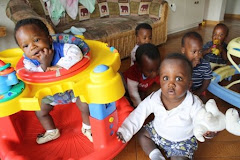
February 14th was New Life Home Trust’s 15th anniversary, celebrating the rescue of over 1,000 abandoned and HIV positive babies. All the babies in the Nairobi Home (48 in total) came out for the day dressed in red and black – our little Valentines. When the toddlers saw the bouncing castles and other monstrous inflatables in their normally serene “front yard” a lot of screaming and running ensued. Every year, apparently, our babies pee their pants over the bouncing castles.

I will be sad to leave New Life Home Trust this week. My last day with them is Friday.

no more monkeys
At the end of January, I moved out of that great house with the monkeys and the trees; and am now living where I work – on the New Life compound. My commute is 20 seconds across the courtyard. Really rough. I'm back to my one-room, dorm-room that I lived in when I stayed in Kenya for 6 months in 2007. I feel a bit "cooped up" like a chicken, but it's fine; and besides, I’m moving again this weekend (to the guest house down the street from the New Life compound).

but one more monkey story
7:15 a.m. Sunday

I hear the monkeys “land” on the roof and herd around like furry elephants, making me grumble and grump – It’s too early to get up! But get up I do. Slinging my camera around my neck and out I go into the misty yard hoping to get a good shot of my “pet monkeys” to show everyone. They’re all over the ancient trees. Leaping, reaching, grabbing. They think my camera is a weapon. Every time I point it at one, they run off.

I’m standing, peering up into trees so tall – I didn’t know trees could be so tall – my neck at 90 degrees. I’m wearing pink flannel PJs and flip-flops. The guards are watching me watching the monkeys who are watching all of us. Some baby monkeys are curious, so they’re coming closer. They’re on a low wall now. So I gently approach, not seeing the two on the ground. One is a tiny baby and he hollers bloody murder! His mama monkey swoops in, picks him up, and carries him under her belly to safety. I think, This’ll be a great picture! so I’m chasing them, taking photos until they disappear. I turn around just in time to see this mid-sized male monkey on the ground running on hind legs with arms outstretched straight at me. He looks like he wants to spook me – a little gray ghost. I don’t know whether to laugh or run. He’s three feet from me. What would he have done if I hadn’t turned around just now? Pants-ed me? Jumped on my head? Bit my toes?

No matter. I turned in time, held up my camera and scared the little guy off.

I can see now why my neighbor let those monkeys have her backyard.

cockroaches and pansies
In moving to the New Life compound, I’ve left the land of monkeys and ancient trees for cockroaches and chicken coops. Downhill from here?

Last week I heard a “thwack” near my head and then felt something running on my arm. A mouse? A gecko? I shot up out of bed, threw on the lights, tore off all the covers and shook them furiously. Nothing. My imagination? Perplexed, I eventually returned to bed and eventually turned off the light and slept somewhat paranoid-ly till morning.

I know I’ve got to toughen up. I’m a pansy transplanted in Africa.

When I went to my closet in the light of day I almost stepped on this 2-inch cockroach – upside down, legs flailing in the air trying to flip himself over. I didn’t know what to do with him, so I left him and went to work. Later that day, Kim (my Pioneers leader) came over. I asked her how to get rid of him. She promptly replied, “Pick him up by the legs and toss him out.”

Then I watched her do it.
And the cockroach was still alive.

Though Kim is tall, blond, and beautiful I called her a “tough African woman” – 8 years in Sudan and 2 in Kenya – that cockroach was nothing to her. Something to strive for.

round 2 – ding
The fight against “Culture Shock” continues.

In my worst moments, I think that the sewers of Nairobi are in my intestines, and all of my hair is falling out, and I’m going to be jumped by mosquitoes and cockroaches in my bed at night. And these chanting tribal-man sounds pass through the street some mornings waking me up. And I hate Africa sometimes. And I hate that I hate it.

anne geddes?
I’ve learned that in cross-cultural work, you end up doing things you’re not really qualified to do. Thown into the deep end for one reason or another. My co-workers discovered that I have a nice camera and can take semi-decent photographs. So Mary Beckenham, our founder-director, brings this Anne Geddes calendar to me the other day and asks, “Can we do this?”

Anne Geddes! (You know, the photographer famous for putting baby faces in flowers?)
I said, “Sure.”
What was I thinking?

I’ve since learned that Anne Geddes makes it appear a lot easier than it is. Babies and toddlers are movable, capricious beings. The other day we were trying to get 3 toddlers gathered around a baby swaddled in a cloth and lying in a rustic basket. Trying to recreate the “Jesus in the manger scene” for holiday cards. I had it in my head, but bringing it to life was another story. By the end of this 2 hour “photo shoot nightmare” I was pouring sweat. It went something like this –

“Get that baby outta here” (he’s throwing a fit)!
“Reuben has snot coming out of his nose!”
“We need tissue. Lots of tissue. Where’s the tissue?”
“Koros, take your thumb out of your mouth.”
“Where are you going? Come back here please…”
“Babies, babies – look over here!”

Clapping, singing, shaking rattles and noisemakers – trying to get these little subjects to do just want you want. I don’t know how Anne Geddes does it. I say she’s worth the millions she makes.

endemic poverty
I keep reading and hearing –

The phrase
endemic poverty,
it means

Characteristic of a place
indigenous, almost,
as if it’s always belonged here –
but how can poverty be endemic
to a place? Especially this place. This garden
of Eden, this home of
Mt. Kilimanjaro and eighteen-inch
roses for export and ivory
tusked elephants?

Endemic? No.
Man-made, more like.

Jesus will defend the afflicted
among the people
and save the children of the needy.
He will crush the oppressor.

He will endure as long as the sun,
as long as the moon,
through all generations.


Psalm 72:4-5

January 30, 2009


hanging loose in the Big Nothing

“Against your will you are forced to experience the euphoric horror of floating in emptiness, your moorings cut for good. It is an emotion which has slowly corroded all your ties, but is also a constant vertigo you will never get used to.

This is why one day you have to come back. Because now you no longer belong anywhere. Not to any address, house, or telephone number in any city. Because once you have been out here, hanging loose in the Big Nothing, you will never be able to fill your lungs with enough air.

Africa has taken you in and has broken you away from what you were before.

This is why you will keep wanting to get away but will always have to return.”

- Francesca Marciano, writer

strine

I didn’t anticipate learning to speak “strine” when I came to Africa.

Strine is Australian lingo. It’s the blending and speeding up of words – long words, several words – into shorter phrases. I don’t know how my leader – Peter – manages to crunch 10 syllables into 2, but somehow he does. For example,

Did you have a good weekend? In strine becomes
Djuvgdwe-end? (or something like this)

I stare blankly a lot. I say “What?” a lot. I raise my eyebrows a lot.

I probably understand three-quarters of all that Peter says. So we all laugh a lot, mostly at me, which makes for good bonding. And I’ve found that my Australian leaders, Peter and Kim, are very patient with me, displaying a great a sense of humor and grace.

This is a picture of my great, strine-speaking leaders. (smiles)

tp

Grocery shopping expeditions. All of the packaging continues to look foreign to me. So unless I really take some time reading and comparing items, I can easily grab the wrong thing. The other day, for example, I needed toilet paper. What did I grab? Paper towels.

Now I have a roll of paper towels sitting in my bathroom.

the phone

My leaders asked me on Christmas if I wanted to “ring my folks.”

I said, “I don’t know how.”

“Maybe they can ring you,” they suggested.

“They don’t know how either!” I say. The phone continues to be a great mystery and challenge.

The store sold me international calling cards that didn’t work. Upon googling this brand and doing a little research, I found that there is a lawsuit against this calling card. So the “line” has been disconnected. Why then do the stores still sell the cards?

Why? Because TIA. This Is Africa.

(I try not to say or think that while rolling my eyes and exhaling hot air. I know I’m supposed to try to gain an understanding for all that I don’t understand or want to dismiss as “stupid” or “ridiculous.” But most of the time, I’m no saint.)

must not love dogs

“Where do you live?”
“Westlands.”
“Oh, that’s far.”
“Yes, it is.”
“Who with?”
“Well…” I hesitate. How do you explain house and dog “sitting” to a Kenyan? “Well, my friend is in the US visiting family, so I’m taking care of her house and her – uh – dog.”
“Her dog? Guy!”
We laugh.
“I know,” I say.
“What does he eat?”
“These little pebbles of food. It’s food made for dogs.” I feel stupid. Kids are starving here.
“Food for dogs?”
“Yes.”

When I see myself, this aspect of my culture,
through their eyes,
it looks absurd.

Could it be a farse?
A comedy of errors?
Can dogs really be a million dollar business
in America?

playing chicken

If my driver would stop playing “chicken” with bicyclists on the morning commute, then I could stop holding my breath and expanding my lung capacity. Bicyclists have no clue that he’s coming that close to their rears before he swerves out to avoid hitting them. I move my body to the left or right, as if I’m playing the Nintendo Wii, hoping I’ll move the car and save a life.

I mean, I just don’t get it. Even if there’s a ton of room to go around the pedestrian or cyclist, the drivers don’t. I am afraid we will one day maim or kill someone on the way to work, forcing me to deploy my hostile environments and first aid training.

pulling out my hair

I know I shouldn’t be pulling out my hair as I’ll need it for my bridesmaid’s dress this spring, but I want to. It relieves stress.

Friends and family sent me e-cards for Christmas and it takes me 5 days to open them.

Net’s down.
Net dropped me.
Re-load page.
Refresh. Refresh. Refresh.
Argh!
Is this e-card worth it?
Give up.
Do something else…
Try again.
Dropped gain.
Refresh again.
Re-load again.

You get the point.
Five days of perseverance.

The e-cards were worth it, though, keeping me in touch with another world.

Who will cry for these babies?

Ryan died last week. He was only 150 days old. He came to us extremely malnourished. His little head disproportionate to his body as his brain grew but his body refused to keep up. His mother left him in the marketplace. Ryan died during the night, our nurses with him. Since the time I arrived here, I’ve witnessed him receiving such special care – the nurses, care workers, and volunteers so gentle with him.

But I find that “the world not as it should be” when a baby this small passes away without the grief of a mother or a father to fall on him.

Mary Beckenham, one of New Life’s founder-directors, opened our office door with tears in her eyes and told us the news of his death, saying, “He’s happy though. He’s up there with all our other ones.” All of the other abandoned infants who lived but a few days, or weeks, or months, within our care.

And so we grieve, but not as those without hope, for we know that a new day is coming.

“Look, I will create new heavens and a new earth.
The former things will not be remembered,
nor will they come to mind.

Never again will there be in it
an infant who lives but a few days…”

- God (in Isaiah 65:17 & 20)

January 15, 2009


these woods

I live in the middle of these woods, these glorious trees surrounding my house, hugging up against it, hiding me away. I wish I knew their names – these trees – because maybe then I could convey their beauty. But I doubt it. I think they’ve seen much. And have stories to tell. Wires run through and beneath their branches, forming an electric wall around this compound. Every hour or so, one of our three Kenyan guards walk through our compound and press the button which keeps our wall “electrified.” I am insulated from Nairobi – Nairobbery – right now.

dogs barking
in the pit of my
stomach a slum
groans nearby but i can
skirt around it
take the right roads
and i’ll never know it’s
there a million-crammed
full. right now i’m running
with the rich
with the white
with those in semi-flight
from Reality – the real
Nairobi doesn’t exist here
doesn’t co-mingle with
those with whom i mingle.

the burning

Is the world on fire? I wonder most mornings at eye-lid opening. The burning of things, constant here. Smoke wafting into the air and into my eyes. I have the red eyes of an old African woman, a mzee (mu-zay), bent over metal pots of pilau.

Sometimes, the burning smells like feces.

Other times, the burning smells like the campfires of my childhood or bonfires with friends.

work, work, work

What do I do with my days? I work with an all-Kenyan team in the Public Relations office of New Life Home Trust (www.newlifehometrust.org ) to advocate for the orphans and vulnerable children in our care. We write grants, plan publications, get the “donor dollars,” etc. I’ll be finishing up with NLHT until mid-February and then transition full-time with Pioneers into regions beyond Kenya.

my pet monkey

We have monkeys swinging all over the place. I counted a family of ten the first week I was here. A friend of mine e-mailed me about my “pet monkey.” Hardly! She told me to throw that guy a banana once in a while. She has compassion because she doesn’t know that the monkeys around here are little bullies. For example, my neighbor can’t even sit in her backyard because the monkeys rule the roost. So she’s moved her table and chairs out front.

And who knew that cute gray monkeys could make such hellacious noises? I kept looking in the trees to identify the culprit – thinking it an ugly vulture or carion bird – when out swung a fuzzy little monkey talking up a storm, airing his complaints to the entire neocolonialist community and their dogs.

When I get home from work, I check the two bundles of bananas hanging on the two trees in my backyard – checking for signs of yellow. I’ve got to pull them before the monkeys do. They’re my bananas! Game on, monkeys!

the banana count

The Kenyan women peer into the pot of food I am heating on the stove at lunch – I worry, What are they thinking? Am I eating weird things?

“Ah, you can cook! Wow. Surely, she’s a good cook,” they say to each other.
“Yes, it surprises even me,” I say.
“How did you eat in the States?” they ask.

I honestly have to think for a second and then remember a nickname a roommate gave me – Leftover Queen. I would go out to lunch and dinner constantly with friends and with the enormous portions served at most restaurants, return home with one or two more meals to put in the fridge. So I hardly cooked.

Here, I cook a lot. And mostly from scratch – soups, stews, pasta sauces. I am amazed that it’s actually edible and enjoyable to do. I can’t believe I am saying this, but I like cooking.

So the Kenyans told me this week – “Take a banana.”
“No thank you,” I say gently. “I don’t want to take your food.”
“But we counted you for a banana,” they press me.

Then I got it. They counted me for a banana! Counted as one of them. So they’ve been feeding me bananas and sweet, Kenyan chai along with much laughter mid-morning, every day. This feels good, being taken in.

Michael Jackson mask

Confession. You know those white “germ masks” that Michael Jackson used to use to cover his mouth when out in public? Well, sometimes I want to be a freak and wear a mask around this polluted city. I feel as if I could chew the air at times. In fact, it’s so thick in places, you can’t help but consume it until you feel nauseous, approaching vomit point. Does Nairobi cancel out California’s Clean Air Act?

unpacking my mind

Unpacking your mind. That’s what psychologists and culture-entry experts term the processing of your culture shock, the thoughts and feelings that accompany your move into a foreign culture. It describes the entry phase perfectly – when you’ve unpacked your bags, but not your mind. Your mind is full. Brim full. But you don’t know what to unpack first – where to start? So you keep sitting on your suitcase, keeping it all stuffed in there. Contained.

My life is finally “arranged” into semi-coherency here in Africa. Trying to figure out how to get from A to B, how to get money, how to not get mugged, how to trust perfect strangers who look and speak differently than I, how to use the phone, how to say please in Swahili, how to count money.

I’m a toddler again.

It’s all so complicated and different. I don’t know much of anything anymore.

One thing I really like – I can grocery shop while stuck in traffic. Bananas, mangos, passion fruit, newspapers, passed through my window. I hate grocery shopping, so this provides a modicum of efficiency for me – I may be wasting time in a traffic jam, but at least I’m gaining it back by getting my grocery shopping done.

What a time-oriented American, huh?

Thanks for letting me unpack my mind ...

December 23, 2008


Santa

Here, billboard Santa is an African man wearing a green-and-white Santa suit. Sometimes Santa wears purple, depending on his mood.

I don’t know what to think about this (as well as many other things).

for me, this Christmas

People ask me about Christmas. Am I going to miss Christmas in the States? Do they celebrate in Kenya? What will it be like?

I put up two tiny, fake Christmas trees and some decorations in the house. It helps me “get into the groove” of Christmas. Whatever that means. Honestly though, a part of me feels excited to begin new traditions. To experience Christmas somewhere else in the world.

Besides, I think,
what is Christmas really and
how can it be truly celebrated
when there are those
without a Christ,
without a redemptive birth
to celebrate?

I do miss family and friends and (some) traditions (I’m not superhuman!), but the love of God compels us into outer darkness. I try not to dwell on my losses, but my gains. My first Christmas in Africa and I intend to enjoy it to the fullest.

“You can kiss your family and friends good-bye and
put miles between you,
but at the same time
you carry them with you in
your heart, your mind, your stomach,
because you do not just live in a world
but a world lives in you.”

- Frederick Buechner in Telling the Truth

into the east

“After Jesus was born in Bethlehem in Judea,
during the time of King Herod,
Magi from the east
came to Jerusalem and asked,

Where is the one who has been born king of the Jews?
We saw his star in the east
and have come to worship him.
”

Matthew 2:1-2

Just before I left California for East Africa, I would take evening walks almost daily. I was staying in a house on Big Sky Drive, perched at the base of a spectacular mountain ridge (which most of you know) called Wildwood.

Every evening, I had two options: walk west or walk east.
Every evening, invariably, I chose west.

West was the obvious, the natural choice – the choice of my flesh. In the west, the sky absolutely glowed in layers of pink and orange. Palm trees shimmered and reached for the cloudless, impeccable sky. Why would I not walk that way?

But one evening, as I descended the front steps, I felt God’s Spirit urging me, Turn left. Head east.

So I did.

I found myself surprised by the beauty I saw in that direction. A beauty less obvious, but there, nonetheless. A pink glow in a twilight sky. Refracting mountain faces. Blinking stars. And as I resisted the temptation to look behind me, at the burning center of the fiery sunset,

God’s Spirit spoke –

about the Church being willing to go into the east.
about being willing to move away from
the beauty, the glory, the light
about being willing to go into the outer darkness.

Just as a star drew men of wisdom into the east
and a Savior chose the east
for His descent, the east
continues to call forth
light carriers
truth proclaimers
teachers
artists
painters
servants –
ultimately, voices proclaiming …

O God our Savior,
the hope of all the ends of the earth
and of the farthest seas –


Psalm 65:5

Merry Christmas everyone.

p.s.
winston, churchill


What’s an East African Merry Christmas wish without an orphan story?

The toddlers continue to pass by the PR Office window and say, Hi, Hi, Hi. They continue to go for their Wednesday walks to the Ya-Ya Centre (shopping mall) saying, Ya-Ya, Ya-Ya as they go. The oldest toddler, Ken, says, Jah-Nay and puts his hand through the window like a tiny politician.

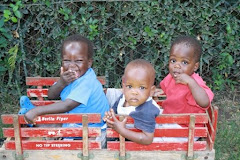
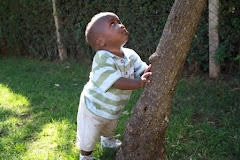
But by far, my favorite is Winston. I call him Winston Churchill. He's just learning to walk and so walks sideways and in zig-zag fashion past our window. Gotta love the little guy. There’s a picture of him below to make you smile and consider adoption...

“Courage is what it takes to stand up and speak;
courage is also what it takes to sit down and listen.”

- Winston Churchill (the real deal)

December 19, 2008


i’m safe
i’m sound
i’m settled


one-way ticket
Well, I’ve successfully used my first one-way ticket.

Day 1, in Nairobi, my luggage never showed up on the conveyor belt. Everyone from my entire flight had already gone. So I asked the attendant about my bags. And somehow they appeared from the back. Then the two attendants sort of stood there awkwardly looking at me like, waiting… So I gave them some Kenyan Shillings. Not sure if that was the right thing to do or not.

Let the cultural blunders begin!

a baraka
Of course, my first e-mail from Kenya would include Barak Obama, who is now apparently the most famous Kenya ever to have walked the planet. I was only in-country six days before a Kenyan brought him up.

My taxi driver, Alex, was asking me about the babies at New Life Home Trust (www.newlifehometrust.org). “How many are there?”

“Fifty-five,” I say, “at this home. But we have 170 in total right now.”

“Where have the parents gone?”

“Some of the moms have died. And some of them have run off and abandoned the baby because maybe they can’t afford to care for them or something...”

“That’s not right,” Alex says. “I believe a baby is a blessing – a baraka.” He emphasizes the word baraka and looks at me.

“Yes,” I laugh. “A baraka.” And off we go into a mini-political discussion.

I imagine every road will lead there for a while and just when I was grateful to escape the American political scene...here it is. People on the streets are even sporting t-shirts with
Baraka’s face.

neocolonialist
I feel like a neocolonialist and I didn’t intend to be, but I think I’ll enjoy it while I can. I’m living a life of privilege these first two months in Africa. A friend of mine who works as a US foreign diplomat asked me to house and dog sit for her while she’s in the States for two months. Free rent.

So I’m living in a banana-tree, monkey-lush paradise with a chocolate brown lab named Yogi to look after. (Though, admittedly, the dog annoys the heck out of me most of the time, he’s the only real downside to the housing situation. We’ll have to learn to make peace with each other.)

I have house help 5 days a week (my friend wanted to keep her national staff employed while she was gone to help them financially). So George speaks French and cleans the house, does laundry, ironing, dishes, etc. Peter looks after the yard and the dog. Wondering what’s left for me to do? Honestly, not much.

I am blessed.

the morning off-road
Lately, the morning commute has included traffic jams. I hate jams, my driver says, exhaling loudly. Then, at the first opportunity, he turns the steering wheel and drives off the road. And we’re not in a 4x4. So we’re basically trekking through a dry riverbed, bottoming out, scraping, dragging, tilting sideways. I’ve been debating whether or not I should take a sedative before we head out in the morning (just kidding).

My internal dialogue?

Oh, God, please don’t let us tip over.
Can a car this size even tip over?
What if we get stuck?
Do I have the right shoes on today?
I need an Aleve.
I have a headache and the day hasn’t even begun…


On good days, my commute to New Life Home Trust takes 30 minutes on paved roads. On bad days, 40 – 60 minutes, including off-roading.
I’m in the office 5 days a week.

reunion
It’s been a fun reunion to see all the old, familiar faces at New Life Home Trust. It’s gone something like this:

Janelle, hi!
Janette - how are you?
Janay, you’re back!
How was the States?


It’s been fun. And I know only one baby out of the whole crew. They’ve all grown up, gotten adopted, or transferred to another home.

baby Janay
Baby Janay got adopted by Kenyan parents! This is good, according to my co-worker Kyeni, because she was not a nice girl. She was biting the other children, and was generally, quite unhappy.

Apparently, baby Janay turned into quite a little terror.

ode to my airport entourage
A zillion people took me to the airport. OK, not a zillion, thirteen. Thirteen people in three cars. An entourage. I've never had an entourage before. It was amazing! I could get used to this. The guys carried my bags. I didn't lift a little, polished finger. We laughed, we walked, we talked. My entourage made time pass. They took me all the way to the luggage screening. Then it became a spectator sport. Me – a monkey in the zoo. A glass wall separated us, so they pressed their faces against the glass, smiling, waving, mouthing incomprehensible words. I was removing shoes, liquids, and laptops into trays for TSA screening when Thomas and Al began to re-enact that scene in My Big Fat Greek Wedding where she's in her office and he's outside her window walking like a duck, getting shorter and shorter until he disappears and smashes into an old lady for a purse-bashing.

my entourage brought
joy&levity
to the parting –
what a blessing
are you, peeps!

asante sana.
(thank you, so much.)

jazzercise
At LAX there was a lady doing jazzercise right in the middle of the sit-and-wait & avoid-eye-contact-with-people area. This of course, made me want to quickly make eye contact with someone so that we could share a knowing laugh. The jazzerciser jumped and bopped. She did side bends, arm reaches. And no one in the entire area even batted an eye. I know, because I batted an eye and kept searching for a laugh, but no one noticed.

The surreal world of travel already begun…

October 28, 2008

rocket scientist
I recently took a short vacation with a friend from high school who now works in the entertainment industry. She asked one of her Hollywood producer friends to drive us to the airport. He picked us up in his BMW, threw our bags in the trunk, and off we went. Somewhere in between Sherman Oaks and Century Boulevard, he looked at me in the rearview mirror and asked, “What do you do?”

I said, “I work with orphans in East Africa with a Christian organization.”

He’s driving. His mouth drops open. He looks sidelong at my friend in the passenger seat and then back at me and gapes, “Are you serious? Is she serious?”

My friend giggles. Says yes.

He says, “It’s like the joke when you’re meeting someone for the first time – ‘I’m a rocket scientist. No really. I’m a rocket scientist. Here’s my card see – it says rocket scientist.’”

We all laughed and he went on, “And here we are talking about useless Hollywood b.s….and you…”

I’ve never gotten that kind of reaction before, but I hope it can only point to Jesus. It’s only because of His grace that we live and move and have our beings.

no mascara days
Don’t know why I applied mascara today. It’s gone and run off.

These are no-mascara days.

Most days I’m excited, I’m ready to leave. I tell myself – Janay, you’ve done your grieving. Don’t go there.

But then there are days like these in which I find myself savoring my “last suppers” with all of my friends and family. It was strange watching some of my friends bond over cheesecake last night knowing that I won’t be there to walk alongside them in the near future. I won’t be in their daily lives. I won’t know what’s what and who’s who anymore. Outta the loop.

And who do I leave my best friend with?
And who will be my mother’s daughter
or my father’s girl?
And the “repatriation of remains”?
Why must there be
such an ugly term
in my health insurance paperwork?
And who will sit in my office chair
and laugh with the church staff?

Who will fill the
hole that I am
leaving?

I’m cleaning out my desk. Shredding some files, packing others. Prepping to go.

Gideon’s girl
To Gideon, God appeared. His angel said – The Lord is with you, mighty warrior. (The angel said this to Gideon while he was hiding from his enemies in a winepress. Not exactly acting the part.)

I can totally relate.

God asked Gideon to do something risky and Gideon gave the excuse of being “the least” and “the weakest.” The words from his lips –

“But sir –”
“But Lord – ”

Excuses. Buts.

Then God said –
Go in the strength you have
and save Israel out of Midian’s hand.
Am I not sending you? (Judges 6:14)

The strength I have is next-to-nothing, but I have the Lord. As I go in my next-to-nothing strength, God will supply my lack. For He wants His children saved. These orphans, these beautiful little ones, are His. He will save the children out of the enemy’s hand. Not me.

Is He not sending me?

He is.

Come up
out of this hole
in the ground wine
press, meant for pressing
grapes, not men,
not me, and
go in the Name
of the Lord.

one way tickets
I purchased my first one-way ticket. What a strange experience. No return date? You kidding me? What am I doing?

One way tickets, a sign of life relocation. Your life is not your own, you were bought at a price, therefore glorify God in your bodies… (1 Corinthians 6:19-20)

(Though, as many of you know, my best friend is planning on getting married next spring/summer, so I will definitely be back for that!)

November 19 is my official depart date.

... I’ll be serving in East Africa for an initial 3 years.

October 15, 2008

I just returned from my final training course in Virginia. This is really, truly, the final one. I promise. I am so well-trained now, I just don’t know what to do with myself except go to Africa!

the green light, finally blazing
This week I got the official green light from our US Base that I can go ahead and purchase my plane tickets. I can’t believe it is finally here. I am so excited and ready to go. I am looking to depart toward the end of November! Thank you for all of the financial and prayer support that literally flooded in, making my launch possible. Thank you for sending me.

hostile environments
Day One of HEFAT - Hostile Environments and First Aid Training (run by former British Royal Marines)

Pulling up to a farm tucked away in the Shenandoah mountains, the games began. There were 13 of us in the car, pleasantly visiting, getting to know each other, still digesting our breakfasts. There were journalists from the NY Times, Associated Press. There were military engineers headed for Iraq to set up systems. It was an interesting group of people. I was the only “aid worker,” as they called me.

So our driver got out of the van to “open the gate” when a loud explosive device went off. Our five trainers came running up, holding AK-47s, camouflaged from head to toe, masked, yelling. Pulled us out of the van. Pushed us face down on the ground in the mud. Put black bags over our heads and cinched them tight. I could hear myself breathing. This did not make me happy. They walked us in a line, laid us face down on the grass and searched our persons. Then we heard the van being loaded up, its doors slammed, and it drove away. Quiet descended upon us.

So what do you do then?
I waited a while.

But you know, I’m not the most patient person. I began to move my hands slightly. Nothing happened. Then I moved my arms in a big way to see if anyone would yell at me. No response. So I tried to take off my black head bag and guess what happened?

They shot me!

First one dead, so the last one to get her head mask removed.

What a way to start the day.

Our trainers said that they get the “kidnap and abduction” training out of the way right away, otherwise people agonize and hypothesize all week about when and where and how it’s going to happen.

first aid training
Day two we put on dark blue, zip up coveralls. Looked like Jiffy Lube personnel. Strapped on “bum bags” – what our British trainers call fanny packs – full of first aid materials and trekked off on the farm to hypothetical traumas.

We would find our Royal Marine trainers lying on the ground under fallen boards, or in car accidents, or burned up next to fires. Fake blood all over them. Wounds looking too real for me to touch. They were moaning and groaning. I wasn’t sure how to react.

At first, I just laughed a lot. Got giddy.

angels of what?
During our second round of real-life first aid scenarios, our instructor began calling my partner, Katherine, and I “angels of death.”

She’s pretty, feminine, and more girly-frail than I. So imagine the two of us at a trauma scene. It was comedic, really. We discussed ad-nauseum how we should address the compound fractures on the leg. We discussed it so much so that the “casualty” lifted up his head, barked at us, and asked whether we were going to “Talk it to death or do something about it.” Then he put his head back down and continued moaning.

Then Katherine wasn’t strong enough to lift the victim’s leg up high enough for me to pass the gauze under it. I burst into semi-hysterical giggles and could hardly contain myself (stress reaction?) In the meantime, the “casualty” – Al, our tough marine instructor – is shooting fake blood at me, simulating an arterial bleed. It’s landing all over my Jiffy Lube coveralls. I’m not too happy about this.

Mayhem. Stressful. Fun.

I make light of it, but the training was invaluable. Well worth the time, money, and energy. I know I will be better-equipped to react in situations of trauma and disaster now, should I encounter them in East Africa.

bruised
Knees and elbows, bruised. Trained in arms, ammunitions, booby traps, fractures, arterial bleeds, cold and hot environment survival, CPR, land mine awareness, kidnap and hostage procedures, compass navigation, etcetera, etcetera. Information overload.

On day three, we took a pleasant walk through the woods where we were shot at, mortared, and booby trapped. We did a lot of dropping and crawling. Hence, the bruises.

By mid-week, the instructors began calling me “trouble” and picking on me (lovingly, of course). One day I wore a pink hat while everyone else was in earth tones. Probably wasn’t my smartest move. And when they needed someone to model a 40-pound bullet-proof vest, who’d they pick on? Me.

Standing there in this bright blue, crotch-covering vest labeled “Press.” Hilarious. It’s a miracle I didn’t fall over. (Though I think that’s what they were aiming for. Comic relief.)

four weeks
I leave in four weeks.

Surreal.

-----
“True mission is the weakest and least impressive human activity imaginable,
the very antithesis of a theology of glory.”

- David Bosch in A Spirituality of the Road

“When the resurrected Christ appeared to His disciples,
His scars were the proof of His identity.
Because of them the disciples believed (John 20:20).

Will it be different with us?
Will the world believe unless they can recognize the marks of the cross on us?”

–Bosch

September 20, 2008

cardboard

I am surrounded by boxes. My life in cardboard. The majority say “pack for Africa.” Hangers, DVDs, Costco-sized Sour Patch Kids, and baseball hats to give away. Kenyans love baseball hats. I had one hat for Koros. He was New Life’s chief accountant in Nairobi, Kenya. From the Nande tribe. He told me he didn’t wear shoes until he was fifteen years old.

Every morning Koros would enter our office in Nairobi with a huge smile on his face and say – “Mwende (my Kamba name), chamge.” That was the greeting in his tribal tongue. And I would reply “Msing” (which I have no idea to spell) – I would basically say “missing.” Everyone would laugh.

Our directors in Kenya recently sent word that Koros was killed in a car accident – a head-on collision with a matatu (public minivan for transport) while driving his daughter back to boarding school. He was 42 years old. The life expectancy in Kenya is 53. Imagine.

The loss is deeply felt. He leaves behind his wife, Rachel, and two children, and many others who loved him.

darfur now

Watched Darfur Now, a documentary on Sudan. Overwhelming – the issues that reside in Africa.

The World Food Programme had to send armed men and armored tanks with the grain just to get the food to the people. The Janjaweed – “devils on horseback” – are a government-funded militia trying to destroy the people for racial, spiritual, and economic reasons. The civil war in Sudan has been raging since 1985, leaving 5 million people displaced and two million people dead.

five million refugees.
two million dead.

One Sudanese woman interviewed in a refugee camp said – “The white people will come and help us.”

Will we?

“Righteousness and justice
are the foundation of Your throne –
love and faithfulness go before You.

Blessed are those who have learned to acclaim You,
who walk in the light of Your presence, O Lord.”
- Psalm 89:14-15

Learned to acclaim God. He must be taught. He must be preached. He must be revealed and explained. Those who walk in darkness have seen a great light…

One of my first journeys in East Africa will be into Southern Sudan, where Pioneers partners with Harvesters – an organization working to realize a world where children are living as disciples of Christ, free from spiritual, economic and social poverty. Check out their inspiring story and YouTube video at www.htrn.org. (You must watch the video - amazing!)

the nutshell

A phrase I keep hearing – I still don’t understand what you’ll be doing… can you please explain a little more… So here’s, in a nutshell, what I anticipate doing:

Reaching Forgotten Children –
Children are the most forgotten people
within every Unreached People Group across the globe


The Challenge
According to UNICEF, there will be 20 million orphans in sub-Saharan Africa by 2010.

The Vision
To rescue Orphans and Vulnerable Children (OVCs) from abandonment, abuse, and neglect. This project will have, as its DNA, a holistic call – meeting the physical, emotional, mental, and spiritual needs of the children and communities in which it is established. We will seek to create sustainable projects to disciple, educate, rescue, house, feed, clothe, and nurture orphans and vulnerable children. We will seek to partner with and establish the local church within each community.

The Region
East Africa - Sudan, Djibouti, Eritrea, Ethiopia, Somalia, Kenya, Uganda, Tanzania, Burundi and Rwanda

The Role
I anticipate serving with Pioneers-East Africa in two capacities: 1) Strategic Coordination and 2) Writer /Photographer for CommNet— a Communications Network

1. Strategic coordination – visiting several countries within East Africa over a 6-12 month period of time, networking with local organizations, identifying partners for development, and praying about the way forward in order to cast a wider net for orphans and vulnerable children.

2. Writer/photographer – telling the stories of the ministries, partners, and orphans and vulnerable children of East Africa. Being a voice for the voiceless.

the campaign finance trail

The campaign finance trail, as I’m lovingly calling fun-draising, has its ups and downs, but overall, it’s going quite well. I’ve been blown away by the almost 100 new faces that I’ve been privileged to meet over the past 3 weeks. I am slowly-by-slowly, as they say in Kenya, headed toward the financial minimums that Pioneers has set for my departure, however there’s still a bit more to go.

departure

My tentative departure date for East Africa has now been pushed back to “November,” contingent upon financial goals being met. So if you are considering partnering with me in this work, now is the time.

“I am carried on the shoulders of those
who cannot see the landscape I describe.
I owe them far more than my weight.”

September 8, 2008

boot camp

I just survived three weeks in Colorado for this training called SPLICE at Missions Training International – designed to prepare people for foreign missions. Our instructor, a heaven-sent, hell-bent provocateur led us through 8 hours a day of intense cross-cultural training.

o We wrestled with practical issues like – Is it OK to bribe or take a bribe while living in a corrupt country?
o We identified losses in safety, identity, and family. Grown men openly sobbed. As a “sent out” community, we grieved over what we were leaving behind.
o We crammed ourselves into a tarp-covered, cardboard box while trying to “survive” a simulated rebel attack. We had to decide who would be air-lifted out by the MAF pilots and who would be executed.

We wrestled.
We grieved.
We counted the cost.

It was like spiritual boot camp – breaking you down in order to build you up. They said if you still want to go into missions after this, you must either be insane or really certain. Or maybe a little bit of both.

(Am i still going to east Africa? I am.)

hoops

That training was my last official hoop to jump through. So my sights are set on raising up the final spiritual and financial partners needed to minister to the children in east Africa. The departure date that I am aiming at is October 22, 2008. (of $3,600 per month and $15K more in one-time departure gifts), so….

the sent

“How, then, can they call on the one they have not believed in?
And how can they believe in the one of whom they have not heard?
And how can they hear without someone preaching to them?
And how can they preach unless they are sent?”

Romans 10:14-15

the rope

I recently heard a missionary from Papua New Guinea speak. He compared a missionary to one being lowered on a rope into the pit of hell.

Who’s holding the rope?

You are.

The rope holders are the people back home. The senders. The ones who pray, the ones who give, the ones who write letters, the ones who don’t let go.

Because I have to say that I am quite certain that I will fall apart in east Africa if you let go. I desperately need people to pray for me, for the ministry, and to not let go. I need people to partner with me in this.

This holding the rope is no small thing.

for the children

“Sometimes we don’t think hard enough about the business of being a witness. Sometimes we think there are two choices: being witnesses or not being witnesses. This is not true.

We are always witnessing to something. The only question is to what are we witnessing.” – Bryant Meyer

God, make your church
a witness of Your Goodness & Grace
to the orphans and vulnerable children
of Africa.

July 18, 2008

“I am the bread of life.”
– Jesus in John 6:35

I recently returned from another week of training at the PI base in Florida. Turns out, there were so many missionaries and missionary kids that there wasn’t enough room to house all of us in the main area. So I ended up in the overflow camp grounds – housed in a log cabin, right on Lake Wippoorwil, complete with a dock, an occasional alligator sighting, a front porch and a porch swing. Oh, and the most important feature? Ducks.

Would you believe that God used three ducks to speak to me?

three ducks

“A missionary is simply a beggar showing other beggars where to find bread.” – Bosch

Three ducks would approach our porch daily, quacking and looking at me expectantly. They stood there on orange, webbed feet, waiting patiently. I knew what they wanted and they knew what they wanted, but every day I told them the same thing: “I have no bread, little guys. I have no bread.”

That’s a sad thing to tell a duck who thinks you should have bread. I began to feel bad. Guilty, almost.

Because the reality was, I did have bread – or access to bread – I was just choosing not to access it.

“Ducks,” I was essentially telling them, “You’re not worth it.” Translation: I don’t want to rearrange my life to get you some bread. (That porch swing was mighty comfortable.)

But the darn ducks continued to beg. One duck was more patient than the others. She would wait long after the other two had left. On my last day there, at dusk, she was getting sleepy, and closing her eyes.

Church, I wonder if it’s not dusk for us and the hour of Jesus’ approach near?
Church, are we living our lives for God’s global plan of redeeming the world?
Church, are we accessing the Bread and showing others where to find it?

It’s not about maintaining the status quo. It’s about getting to those with no access and helping them to Life itself.

I do see them standing there, waiting.

I can’t keep swinging on the front porch. I’ve got to get up off my butt and go.

bringing bread

“Do not work
for food that spoils,

but for food
that endures
to eternal life,

which the Son
of man will give you.”

John 6:27

So God used those three ducks to speak to me about moving further out of my comfort zone and into places where children have no access to Jesus – the Bread of Life.

Within the next 3 – 6 months, I will be phasing out of my current work with New Life Homes in Kenya and transitioning into a new position with PI-East Africa (PI-EA). Pioneers has a heart for pioneering – bringing the Gospel where it has not been before. PI-EA desires to develop and partner with ministries to orphans and vulnerable children in a wider region, to reach the children who are currently not being reached. I feel called and excited to be a part of this.

I have loved the ministry and work of New Life Homes. I continue to believe strongly in its mission and vision, but I feel that it is time for me to take a step of faith into a different role. I feel that the Lord is calling me into a place where my gifts and strengths can be used to “cast a wider net” for children at risk in Africa.

move further

“Our hope is that,
as your faith continues to grow,
our are of activity among you will

Greatly Expand
so that
we can
preach the gospel

in the
Regions Beyond
you.”

2 Corinthians 10:15-16

What I am realizing about PI – about their DNA – is that they are pioneers. (I know, it’s like a big “DUH, Janay.”) They are constantly looking to move into the regions beyond, to greatly expand.

I like this. This is exciting.

One of their taglines is Move Further.

It seems a lot of training is required in order for me to move further  so I am off to Colorado for three weeks in August for this training called SPLICE – it’s a pre-departure program that will prepare me for better integration into new cultures.

perspectives:
where are you headed?


“Christ doesn’t call us
to a prudent life,
but to a God-centered,
Christ-exalting,
justice-advancing,
counter-cultural,
risk-taking life
of love and courage.”

- John Piper, Author & Pastor

May 22, 2008

the poor wanderer
Kenya is starting its “resettlement” program after the recent post-election violence. There are Kenyans living in Uganda, the neighboring country, who don’t want to go “home”. Can you blame them? Their neighbors turned on them, wielded machetes, and burned their houses.

The CWS (Church World Service) says we live in an “era of displacement.” There are 40 million displaced people worldwide. Fourteen million of those are refugees (living in other countries) and the other 26 million are displaced within their own countries. How many of those are children? And women? i don’t know the answer, but i imagine – the majority.

i try to picture their faces. And imagine their feelings. How must that feel to be displaced or uprooted from your home?

Internally Displaced Peoples – or IDPs – is the international euphemism for homeless. No government wants to say they’ve got a problem with homelessness. But displacement? Sure. Displacement sounds like a temporary problem with a quick fix. But is it?

Sudan – Kenya’s neighbor to the northeast – has the highest number of IDPs in the world with 5 million. Imagine half of Los Angeles – homeless. That’s the situation in East Africa today. And current reports from Kenya estimate that there are now 250-600,000 IDPs.

This disturbs me.

God asks –
“Is this not the kind of fasting
I have chosen:
to loose the chains of injustice…
Is it not to share your food with the hungry
and to provide the poor wanderer with shelter –
when you see the naked to clothe him,
and not turn away from your own flesh and blood?”

from Isaiah 58:6-7

God watches the poor wanderers. He doesn’t turn away from them as i’m tempted to do. He’s mindful of their comings and goings. He sees the camps they squat in. He sees them fleeing from conflict. He sees the stagnant water breeding malarial mosquitoes. And He says to those of us who are not a part of the 40 million poor wanderers – Dive in! What’re you waiting for? You want to experience true worship? Fight injustice. Feed the hungry. House the homeless. Clothe the naked. And watch your light break forth like the dawn…and your healing quickly appear…

Here are the latest prayer requests from Kenya for the humanitarian relief efforts being carried out by New Life Homes/Barnabas Ministries Africa:

Pray for:
● The displaced children being supported by NLH/BMA at Ruiru, Webuye, Burnt Forest, and Kikuyu.
● Finances for displaced children programs. It is estimated that over 500,000 people have been displaced through the Kenya crisis. This is an on-going problem that will not be solved in a few months.

baby Jacob
Those of you who traveled on the last few Rock the Baby teams will appreciate baby Jacob’s progress. The “little lump of love” has grown! He’s now moved from the Crawlers to the Toddlers. i’ve attached some recent pictures from a team from Ft. Wayne, Indiana who just visited our Nairobi Children’s Home in April. Their senior pastor, Kelly Byrd, loved Jacob, too. Easy to love.

As always, thanks for remembering our friends in Africa.

With Love,
Janay

March 21, 2008

path to peace
Kenya seems to be “formally” on a path to peace as government parties are signing “power sharing agreements”, but I don’t hold my breath anymore. Our friends in the Nairobi office say that the country seems to be settling down. It’s safer now to travel around the country and things are going back to normal “slowly by slowly” as they say in Kenya.

Nakuru Children’s Home
As well as being engaged in distribution of relief funds to the projects (please see attachment), New Life Homes has been engaged in rescuing and assisting through its children’s homes. Twin 14 month-old boys, malnourished and sick were admitted into our Nakuru home while the mother received care at a psychiatric hospital.

Kisumu Children’s Home
Our Kisumu home has taken into its care a pre-mature baby whose mother had died and the grieving father was unable to give the necessary care. A nurse at our Kisumu home had her home destroyed and had to flee the area that had been her family home. Now her family is re-settling in Nairobi and she has joined our Nairobi Home team.

my plans
I really should stop using that pronoun "my" - as nothing seems to be within "my" control in this life of ministry. I am still “up in the air” as far as my future return to Africa goes. Don’t know when, don’t know where, don’t know how… many questions still left to be answered and plans to be sorted out. I am in the process of looking for a partnership sending agency to work alongside me in my work for New Life Homes/Barnabas Ministries Africa. I am traveling to Florida in the beginning of April for a 1 week candidate orientation program with Pioneers (www.pioneers.org), a potential sending agency and partner. We’ll see how that goes…

So I am “parked” stateside for now, working on behalf of Africa from here. You can still find me in the offices of Christian Church of Thousand Oaks if you want to find me. 

With Love for Africa,
janay
-----
kibera

kenya coddled
&created
&boasted
of africa’s
second largest
slum. kibera.

those in power
stealing voices
and choices
and hope

the monster kibera
her tongue
caught in her throat
for so long
now screaming &writhing
&thrashing like
a great monster
emerging from the deep
and suddenly we see –

we see the surface
has become the deep.

a people formed for passion
move in rage
because rage gives voice
to the deep, the things
of the heart submerged
for too long.

the soul of Kenya
no more tribal
than the soul of the so-called civilized.

for man is made to reveal the passion
and the shekinah glory of a God who
loves justice
and righteousness –

a God who is, ultimately, good.

and deprived of these truths?

a man-made world
unbearable.

January 25, 2008

up in the air

People have asked me to write. To blog. Forgive me for writing so infrequently while i’ve been in the States. i need to tell you that my plans are –

up in the air –

Yes, my plans are up in the air, where i imagine the hand of God holding them there. The Book of James says not to brag or boast that tomorrow you’ll do this or that, but say, God willing… tomorrow i will do this or that… (Js. 4:13-17). The political and social situation in Kenya has resulted in a temporary postponement of my departure date (originally Feb. 4). i think of myself in a holding pattern at this point. Sort of like a plane circling its touch down point, waiting for clearance from air traffic control.

i’m up in the air.

In the meantime, i’ll continue to work for New Life Homes from the States, working out of the offices at CCTO.

What follows are some snippets from articles i’ve been reading on the current situation in Kenya -

quick stats

o Around 60% of Kenya's population of 37 million lives on less than a dollar a day
o Life expectancy in Kenya has fallen (WHO)
o Kenya is seen as one of the 20 most corrupt countries in the world

(source: Transparency International)

the slums of Nairobi

“In Kibera (the largest slum in Kenya) it is a matter of degrees. Those who have nothing are looting those who have a little bit more.

More than 50% of the people who live in this slum are unemployed. It has a child mortality rate that is between five to seven times the national average. There are tens of thousands of AIDS orphans. And there is no proper water or sanitation or electricity.

All this in a place with nearly a million people. As Walter Kibet, clinical officer with the charity Afrem put it to me: "You see the children getting sick and it affects every aspect of their development."

This population has seen successive governments rob billions from the public purse in well-documented scandal.

Add all this together and you get a sense of what might be driving the rage. It certainly isn't a simple issue of tribalism.”

(source: BBC - http://news.bbc.co.uk/1/hi/world/africa/7205762.stm)

ethnic cleansing?

On Thursday (Jan. 23), Human Rights Watch issued a report accusing opposition officials of helping to organize ethnic violence in the Rift Valley region.

For the full article: http://news.bbc.co.uk/1/hi/world/africa/7208421.stm

rape

“Battles are fought on women's bodies as much as on battlefields.”

- Kathleen Cravero, UNDP (United Nations Development Program)

“Staff in the Nairobi Women's Hospital - one of Kenya's leading centers for the treatment of rape and sexual violence - say they have seen double the number of cases affecting women, teenagers and girls since January.

"Since the beginning of the month, we have had 140 cases of rape and defilement," said Rahab Ngugi, patient services manager at the hospital.

"We were used to seeing an average of about four cases a day, now there is an average of between eight and 10."

Almost half of the cases at the hospital's specialized clinic are girls under the age of 18, Ms Ngugi said. One case was a two-year-old baby girl.”
----
“(A Nairobi-based rape counselor) worries that although the gangs are not yet targeting makeshift, unregulated camps and shelters - in schools, churches and community centers - the women and their children sheltering there are increasingly vulnerable.

The UN says that in the capital alone some 12,000 people are living in public buildings after being driven from their homes.

These shelters should be the focus of concern.

"Many of the internally displaced are not living in formal camps. They are just gathered around a school or church. Then you have the worst-case scenario - where you don't have that level of law and order and you have people living on top of each other."”

(source: BBC - http://news.bbc.co.uk/1/hi/world/africa/7204680.stm )

what’s happening to the children?
“The Ministry of Education, which ordered schools to reopen this week, had no immediate estimate Thursday of how many children were still out of school. But the U.N. children's agency said the conflict has displaced 100,000 children, and some 75,000 are still living in camps that have sprung up in churches, police stations, schools and show grounds.”
(source: Associated Press - http://hosted.ap.org/dynamic/stories/K/KENYA_SCHOOLS_OUT?SITE=CACHI&SECTION=HOME&TEMPLATE=DEFAULT )
mindful

My mind is too full of late. i’m ever mindful of Kenya.

It’s raining outside. i’m sitting on a leather couch peering out of a double-paned glass window, a fire beside me, the heater heating my house. The rain outside doesn’t touch me.

i’m mindful of Kenya.

i’m watching
the rain rush
down our paved streets
through pristine gutters

and i’m mindful of Kenya.

rain like this, there,
doesn’t rush clear –
it rushes raw
sewage and hope
like run-off
never to return.

Thanks for caring about our friends and family in Kenya and for the people whom we’ve never met who are suffering.

Janay

My work address if you’d like to know more about New Life’s humanitarian relief efforts and outreach during this time of crisis – jgarrick@newlifehometrust.us

June 26, 2007

disdain

A friend from the States recently wrote: Will you look at us with disdain when you return?

No!

I love this thought from the Shaliah tradition (Jewish faith): “The one who sends is the same as the one who is sent.”

So, you and I, we’re the same. You’ve been here with me this entire time.

hellos

Another friend wrote in response to my complaints about saying good-bye: Yes, you have many good-byes there, but many hellos here.

Looking forward to the many hellos…

June 18, 2007

jarring moments

I was sitting in the Java House, this very western cafĂ© in downtown Nairobi where Americans, Europeans and wealthy Kenyans drink the brewed coffee (as opposed to the instant Nescaf that the majority poor drink, if they drink coffee at all); so I’m siting there with Mary who runs a school in one of the slums (Mathare). We’re discussing doing the Children in Crisis training for her teachers and social workers. I was enjoying my coffee, the atmosphere. It was a moment of semi-normalcy in my estimation – a flash back to the life-i-used-to-live before following my sometimes radical and extreme Lord. So there I was – good coffee, good planning – and out onto the street walks a stark-raving, head-to-toe naked woman. Walking the crowded downtown streets with a vacant look on her face, the Nairobi business class stopping to stare.

It was a jarring moment. I remembered where I was.

Sometimes, I’d like to forget for longer than 10 minutes.

hard questions

God took me into the slums of Mathare again. I was there in 2005. I remember being touched by the people I met and the work that was being done there – micro enterprise (equipping the poor to start small businesses with small loans), education, counseling/social work, etc. I ran a condensed version of the Children in Crisis training with the Hope Centre leaders. I was so blessed by this group. Forty-five of them packed into one room, spending their entire Saturday learning about the cycle of violence, a child’s basic needs, and how to plan effective intervention.

How do you help a child recover from a trauma such as victimization, loss, family problems, or natural disasters?

These teachers, social workers, and volunteers serve the urban poor – their student population includes orphans and abandoned children, street children, Somali refugees, victims of domestic violence, children of drunkards and drug-users. You name the social problem, they’ve got it.

At the end of one of the sessions on the stages of grief, teacher Raphael raised his hand and asked the hardest, heart-breaking, reality-check question:

How do you help a child process and deal with the trauma when it’s not in the past – it’s ongoing?

I stood there, in the reality of their situation, like a deer in headlights. Humbled. Saddened. No pat answer. Nothing easy-breezy brilliant to say because the reality is – their trauma is ongoing.

I looked at Raphael and said, Gosh – I don’t know. Does anyone have thoughts on that question? Blank stares. I went on to answer another question that I could answer and prayed to God for wisdom. Then came back to Raphael with this – We may not be able to change their home-lives (their shack-lives), but we can provide a place of refuge and respite away from home. When they are with us, they can know that they are safe, that no one will hurt them. When they are with us, they can know that they are loved.

But it’s not enough. As I think about that answer, I am frustrated by its limitations. God is a God of justice. Yes, He sees the reality of these children’s situations and I am convinced that He is grieved by it and wants more to be done.

The questions are –
What?
and How?
and Who?

“He will defend the afflicted among the people and save the children of the needy;
He will crush the oppressor.

He will endure as long as the sun, as long as the moon,
through all generations.”

Psalm 72:4-5

slum water tea

Slum water tea. That’s what they offered me to drink during the training in Mathare slums. No other option. You just have to boil the slum water and hope that it’s killed the unmentionables in the water…

Slum water tea is disgusting.

And after ingesting it, you begin wondering – What’s happening in my body? All that water slumming around in my intestines? But you can’t dwell on it.

And drinking that tea in the middle of discussing psychologist Abraham Maslow’s hierarchy of basic needs – things a child needs in order to develop (or self-actualize) into the person who God created them to be. The foundation of a child’s needs? Physiological needs such as food, medical care, access to clean water… These things are necessary for simple survival. And all of these beautiful children – thousands upon thousands – in these slum communities are denied these basic necessities, these basic rights – by the people in power.

But – I wonder – Are the people with true power those in government or those in the Body?

trauma

It’s so ironic that I go into these places and teach about trauma’s impact on children and I leave such places feeling traumatized myself. I go home and cry. Or watch a movie I’ve seen a thousand times so that I don’t have to think about it.

I’ll never accept it! God’s people, God’s children living in deplorable, sub-human conditions.

We must do something! We must take care of “the least of these” (the children, the vulnerable, the marginalized) in the name of Jesus. We’re no longer ignorant of these things – and we’re His Body – His broken heart and strong hands, His voice in the world.

“Defend the cause of the weak and fatherless,
maintain the rights of the poor and oppressed.”

Psalm 82:3

June 5, 2007

funny phrases

“You look like a statue.”
“You look like a doll.”
“Your feet are so clean.”

All funny phrases that’ve been said to me. These Kikuyu women crowed around a friend and I at a roadside fruit market outside of the city. They were inspecting me intently. What did they see? “Her feet are so clean,” they tell my friend. “Leave her here with us.” “No, I’m not leaving her here,” my friend tells them! What do I make of such a strange interaction?

Sometimes I don’t know where I am. Nothing makes sense. I have no frame of reference for understanding. Everything needs translation – even English!

ghetto heaven

Sometimes I’m just hanging on by my fingertips to the ledge of Africa, trying to survive this place. This is Africa, I tell myself. What do you expect? Forget what you’ve left behind…the riches of an American heaven…

Driving back to Nairobi by bus from Mombasa this weekend, we passed a highway town with this sign:

Ghetto Heaven Bar

Cracked me up. Ghetto heaven. What a ghetto heaven Africa is indeed. A paradise lost. You can see what it used to be, what its Maker intended it to be, but what it’s become? Ghetto heaven. Spoiled rivers by plastic bags and pollution. Landscapes littered with leggy giraffes, shanty towns, and the endless poor. The endless poor – sitting, standing, staring, wandering about the ghetto heaven streets all day long. Do they work? Are there jobs? Is there purpose in their lives?

“What are the most pressing national challenges (Kenya) faces? We have today 10 million Kenyans between the ages of 10 and 18. It means that between now and the 2012 elections, we need to have created eight million jobs. We are looking at the prospect of unemployment rising from two million to five million by 2012.”

Imagine that stat coming into reality here!

“The consequences of five million unemployed energetic and disillusioned young people is crime, rural destitution, urban squalor and the potential of political strife too dire to contemplate. Youth unemployment is the greatest threat to political stability.” (Uhuru Kenyatta in the Daily Nation, March 16, 07)

Diani Beach

Went to Diani Beach, South Coast Mombasa this weekend with some girlfriends from the office for a wedding and also to see our New Life Home – Mombasa. What an adventure.

I am so happy to be back in Nairobi if you can believe that. The trip was exhausting. Both ways – coming and going – we traveled in the pouring rain over pot-holed roads. We left by night bus from Nairobi on Thursday and traveled all moonlit night for 9 hours to Mombasa. I slept most of the way, so the trip there was fast. The moon lit the landscape beautifully.

Coming home to Nairobi was not so easy. We left Diani Beach as it had just started to rain. Ended up with the craziest of crazy matatu (public minivan) drivers, passing other drivers on the highway at high speeds in the torrential rain. The town bridge was “down” due to the rain, so our driver pulled off the main highway and onto this side road. The side road was completely flooded – a river. There’s another matatu 50 yards into this river road, stalled out. People are outside, waist deep in water, pushing it. As they are pushing the car, they wave to our crazy driver to come. Come?! I think, Are you nuts? I’m quickly thinking that our driver has proven himself to have limited cause-and-effect thinking and the friend next to me leans over and says, “You can start praying.” I said, “Don’t let him go that way. You need a boat to pass there.” So everyone at this point starts talking in Kiswahili and I’m left out of the loop. After a few minutes debate and internal praying, we back out. Thank God.

My friends later teased me that it would’ve been OK to go that way. Said we would’ve just sat in the car and let them push. They laughed at me for saying something. Cultural clash. We ended up finding an alternative, non-flooded route and making it to our bus barely on time, but it’s a hard call – trying to figure out what things to let go and what things to speak up on. Things are so different here.

spoiled?

The road trip was like this during the day – baobab tree, shrub, shrub, baobab, shrub, baobab, shrub, shrub…

I’ll take flying any day of the week and twice on Sundays. Call me spoiled – my Kenyan friends do – “Guy, Janay, you’re spoiled girl.” Yup.

beach boys

One thing we don’t have much of in the States are annoying beach boys. They come up to “befriend” you in order to offer you something for sale, or a marriage proposal, or some other come on. Madame hello. Hello … pretty lady – hello --?

I finally told one – “Look, I want to be alone, OK?”

“Yes, but we’re never alone,” he says referencing the sky with his arms. “There’s God and the angels.”

“Yes, and I just want to be with them now, OK?” I say.

OK. Sawa. He leaves.

You feel mean, but it has to be done! It’s tiring to always be on your guard. There’s little rest even in restful places here.

witches

Saturday night a group of us sat at the beach’s edge under the full moon and a witch came out. No joke. A witch.

It was a single woman. She picked up a large bunch of shrubs or flowers and began waving them over the water’s edge in this rhythmic way. At times she would run, arms held out in front of her, as if her wrists were bound by ropes and something was pulling her forward. She stomped, talked, moved in strangely patterned and chaotic ways. It was creepy to watch. Something spine-tingly and evil about it. My Kenyan friends seemed scared – “Don’t look. Oh, Lord – what’s this? Witchcraft,” they agreed. They’re familiar with it.

Greater is He who’s in you than he who’s in the world, we said in agreement.

The place we were staying at was a Christian retreat center called The Word of Life. The woman walked right through the property and stood on the beach cursing and calling on evil spirits with such boldness.

It’s timely that I saw this because the last pastor that I heard spoke briefly about witchcraft in Kenya – how strong it is as a religion and how many “high level officials” openly practice it.

I think we take it so lightly in the States – charmed, entertained and bewitched by it…

There’s spiritual power in witchcraft. That’s why they practice it here.

suitcases in the corner

It’s so symbolic that I’ve lived with suitcases in the corner of my living room all this time – always there – in the corner of my eye, in the back of my mind. I’m here. I’m not. I’m leaving. I’m staying. I’m gone. I’m present.

The suitcases in the corner are coming out again soon.

I wonder, Can people invest in such a person? How attached can you really get to a nomad unless you’re a nomad, too?

My friends here say – “This is your home. Next time you come, come to stay. Forever and ever. The states are your birth country. This is your marital country.” (They want me to marry a Kenyan – they have an agenda.)

“Somewhere in the world there is someone missing you. Your mom? Your family?” they ask.

“Yes,” I say. But I sure have grown to love Africa and my friends here and the babies. Heart stealers. This see you later will be hard.

The shared grief of the suitcases-in-the-corner life.

London

I have this crazy picture in my head of getting to the London airport – the first sign of civilized ground in 6 months – and kissing it. Isn’t that sick?

May 23, 2007

grab-iosity

Our social worker, Grace, came into our office the other day to use our paper cutter. We told her “That’ll be 5 shillings.” She says, “I see you suffer from the same syndrome everyone in this country suffers from – grab-iosity.”

I love that.

Grab-iosity.

The country does seriously suffer from it. It’s annoyingly so. You feel as if everyone is constantly after your money. Just because your skin is white, you’re rich. And comparatively speaking, it’s true; but it doesn’t make it any less annoying at times.

They’ll say things like – I’m raising funds for…. If I had a supporter I could… Janay, do you have? Janay, do you have? Janay… Sometimes I think if I hear that one more time I will scream!

But grabiosity is also cultural. It’s a communal society (as opposed to an individualistic one). Family is everything – one person is not separate from the others. So if a person makes good money in the family, they’re expected to share with the other family members. My friend said she couldn’t travel upcountry to visit her family until she could afford to bring a bag of rice or maize. You can’t come empty-handed.

Family is everything. You’re defined by your place in the family. They’ll tell you, I’m the firstborn… or I’m the fourth born… or This is Mama Joy. Mama Joy is the mother of Joy. She doesn’t have her own first name, but is defined by her role as Joy’s mother. Good luck finding out what Mama Joy’s first name is, sometimes it takes a while to piece it together.

You see so many poor, young, single women with babies wrapped snuggly on their backs. They’ve gone off and gotten pregnant, usually with some random man, just to get a baby. To be somebody’s mama.

happy story

Here’s a story you don’t hear too often. Last week, we admitted a new baby. The mother had signed the baby over at the hospital – didn’t want him. The next day, the mother came to our home and took her baby home with her.

harambee

Kenyans celebrate the concept of Harambee – the community coming together to put their money into a common pot for the common good – for something like a wedding or a funeral, or for building a home. Everyone in the extended family and friends throws what they can into the pot for Harambee. Harambee means togetherness, unity, sharing …

Even when we were mourning in our office over our friend’s brother’s death, one of our Kenyan friends came in and said, Ah, you’re mourning together. It’s as it should be.

Everything together. The good and the bad, shared.

Harambee.

I like this concept and think that the Kenyans are teaching me a lot about what it means to live in community with other people. It’s not always the easiest, but it’s a picture of the family of God. Unified. Loving. Sharing burdens and joys.

what’s a village?

When I wrote down my U.S. address for one of the rural teachers in Lamu, she asked, “You have villages, too?” Westlake Village!

What do you say? I paused and slowly said, Yes, we have villages, but they’re not exactly like your villages… I wondered if she pictured me in a hut like her? With goats, too? Too funny. I didn’t bother explaining. Some things inexplicable – how do you explain our “westlake village” concept of village to someone living in the bush, drinking goat’s milk and following herds of goats, camels, and cows across the desert?

kingdom of heaven

Some of you will be jealous that I got to hear famous writer and Pastor Brian McClaren speak. He came to Nairobi Chapel, spoke about the kingdom of heaven. Loved what he said – “Churches are not warehouses for the saved, but places of transformation by which we go out into the world and transform it – bringing the kingdom of heaven to earth.” Yes!

My favorite kingdom of heaven parable that Jesus told:

“Again the kingdom of heaven is like a merchant looking for fine pearls. When he found one of great value, he went away and sold everything he had and bought it.”

Matthew 13:35

The kingdom of heaven - it’s worth everything we have and are …

May 7, 2007

the graves are not yet full

“There’s a joke among expatriates in Sudan that once you have drunk from the White Nile, you’re infected for life. In spite of myself, I had to agree. There was something about Africa that got into my blood and stayed there.”

- Bill Berkeley in The Graves are not yet Full: Race, Tribe, and Power in the Heart of Africa

I met a missionary named Joy who was staying with her family in Nairobi, attempting to “take a break” from their work. It struck me as ironic that they would vacation in the heart of Nairobi – which is the center of stress and chaos for me. Everyone’s center of stress – different. Their center of stress is in Southern Sudan. She showed me on the map – placed her finger on a tiny bend on the White Nile river and said – We live about an hour and a half from there. No roads, no infrastructure, no nothing out there except people. But there are groups – NGOs (non-governmental organizations), FBOs (faith-based organizations), churches – building a hospital out there in the middle of no-mans land. While Sudan is still at war after so many years, still at war.

I sat with a “Lost Boy” at dinner, too. Sudan’s lost boys made famous by war. Surreal.

Sudan is Kenya’s neighbor to the north. They say that a country is only as stable as its neighboring countries.

I’m reading The Graves are not Yet Full, trying to get a better understanding of the macro-level forces at work to create the chaos known as Africa. (If you’re into political history, I’d recommend it.) And I agree with Berkley’s comment: There’s something about Africa that gets into your blood and stays there (despite its obvious problems).

nose picking

Funny cultural thing – the Kenyans pick their noses like no others – better than five-year olds digging for gold.

So, we taught the Children in Crisis curriculum with a second group of teachers this week at our New Life School in Ruiru. I’m standing at the chalkboard discussing the most somber and serious of topics – formulating intervention strategies for children in crisis – and this teacher-trainee has his index finger so far up his nostril that his nose is sliding sideways and up and down his face. A grown man! I just kept rambling on.

God is so good, though. He helps me to hardly notice these things. I stay on track and only remember and laugh to myself five hours later.

New Life has a school that educates 100 children (3 - 9 years old) just forty-five minutes outside of Nairobi.

school of teachers (SOT)

The teacher training went really well. It’s easier to teach a curriculum the second time around. This is an area of ministry to be expanded and developed. Potentially, a pair or team of teachers coming in every quarter to teach new concepts, methods, etc.

names

The teachers at Ruiru gave me a Kikuyu (kee-koo-you) name. Each tribe has settled in certain areas of Kenya (there are approximately 39 different tribes in this country). And the Kikuyu are the majority tribal/people group in the town of Ruiru.

So I am Wamboui (wom-boy-ee).

This naming ceremony took all of two seconds, as they only have 10 possible names to choose from. Apparently, Kikuyu women can only be named one of ten names because there were 10 original, tribal daughters.

Imagine in the States – Jennifer, Amanda, Sarah…. Jennifer, Amanda, Sarah…

Oh, wait, we sort of have the same issue, don’t we?

bird watching

The Kenyan birds are amazing! People come to visit Kenya just to bird watch, or so I’ve been told. (I can’t imagine ignoring the elephants and lions, but hey, whatever floats your boat.) Kenya has one of the most diverse bird populations in the world.

After teacher training ended in Ruiru, I went back to the place where I was staying. I sat out on the edge of the field, quiet and still. All these different birds started swooping in, feeding, chatting, taking baths on the red dirt basketball court – some dirt bathers skidding in like crazy-haired maniacs. I’m sure some of you could bust out your bird books and tell me the names of these marvelous creations, but I can’t tell you much more than that. I was smiling inside, unwinding, after teaching about recovery, restoration, rehabilitation, the cycle of violence, attachment disorders, art therapy… blah, blah, blah – heavy things. And I remembered a bit of advice from this Self-Care in Mission class that I took at Fuller Seminary: “Bird watching is therapeutic” or something to that effect. I thought at the time – What an old geezer thing to do! And then, there I was, in Africa, doing just that.

thoughts on machetes

As I’m sitting out on the edge of this property in Ruiru, not another soul in sight – just the birds – along comes an African man carrying a machete in one hand. I think – OK, he’s a weed-wacker. And I noted that he was wearing some kind of uniform. But then he turned and started walking straight toward me. For a split second, I wondered, you know? When he saw me, he dropped his machete in the dirt, then he picked it up and walked past me and grinned a friendly “I’m-not-a-killer” grin, said something, and kept walking.

I find my judgment being constantly challenged, examined, and turned over here. My assumptions often proven false. My trust in God stretched.

Only in Africa do you wonder or have opportunity to wonder what that man approaching you might do with that machete he’s holding. A machete! It just appears so primitive, so violent. A weapon with a long, sordid past on this continent.

Kenyans use machetes to cut hedges, weeds, and tall brush.

But my western mind thinks of the genocide in Rwanda – (Hotel Rwanda) – in which the Hutus hacked the Tutsis to death with machetes. Or I think of Sierra Leone, where the Revolutionary United Front amputated people’s limbs in their diamond mine conflicts.

I am grateful when my assumptions and stereotypes – when the fears that keep me boxed into a small life of small-mindedness – are challenged.

third world rage

Ever seen the movie The Constant Gardener? Most of it was filmed in Kenya, including in Kibera, the second largest slum in Africa. I recently watched it for the second time here and watched the “special features”. They spoke with the director who is a Brazilian (City of God) director. His socially conscious films are often infused with a passion people described as “third world rage.”

third world rage –

I think it’s an inevitable sentiment that you pick up after having lived in or experienced the developing nations of the world. If you allow yourself to look around, if you allow yourself to listen, if you allow yourself to look under rocks and open dark closets – third world rage ignites. It boils over at times and, for me, can turn into depression. Or it just sits there, beneath the surface, constantly pushing me to press on in the fight against the injustice and despair that I am sensing around me. I mean, you have to do something with this rage that you feel or else it will consume you like a fire. The world is unjust – the eyes of my eyes are open – the ears of my ears are awake!

So I write to you about it. Hoping you will come to Kenya and that this third world rage will awaken in you a desire to rage against the unjust too…